
Timing in Horary Astrology: When Can Something Happen?
Can a horary chart show when something will happen? This article explains how horary astrology approaches timing, when a timeframe is clear, and when the chart speaks through process rather than dates.
Astriloqua
12/21/20253 min read
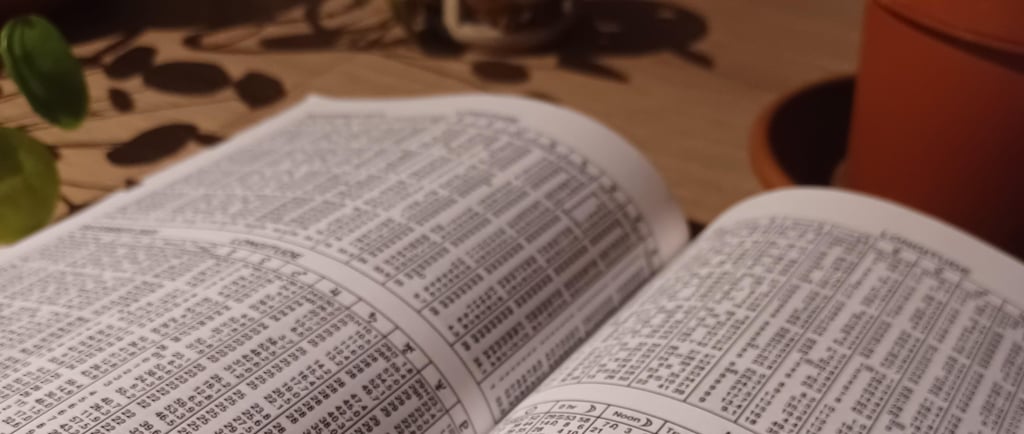
How Horary Astrology Looks at Time — and Why “When” Isn’t Always the Same
One of the most common questions in horary astrology is this: when will something happen?
Will they reach out, will a meeting take place, when will the situation move forward, does it make sense to wait or is it time to change direction?
Time is often what we care about most — and also what causes the most confusion.
In this article, I explain how horary astrology approaches timing, when a chart can give a clear timeframe, and when it speaks not through dates, but through process and development.
If you’d like a broader foundation on how horary questions work and when they’re best used, I recommend starting with this complete guide:
→ Horary Question: A Complete Guide
Can a Horary Chart Show When?
The short answer is: yes — but not always in the same way.
Horary astrology doesn’t function like a clock or a calendar. It doesn’t promise an exact date in every question. Instead, the chart shows the rhythm and dynamics of events: how quickly or slowly something is developing, whether it’s near or far, and whether there is movement at all.
When the question is clear and the moment is right, timing often appears in a very elegant and precise way.
When it isn’t, the chart will usually tell us what is happening rather than when something will happen.
What in the Chart Speaks About Time?
You don’t need to know technical astrology to understand the logic behind timing. In practice, several key elements are considered together to form a sense of when.
The Role of the Moon
In horary astrology, the Moon shows the flow of events. Its aspects describe the next steps and the sequence of developments.
When the Moon is clearly applying to an aspect that symbolizes the outcome, we often gain a good sense of timing as well.
Aspects, Direction, and Planetary Speed
Applying aspects usually indicate that a situation is developing.
Separating aspects, or a lack of contact, often speak about what has already happened, delays, pauses, or slow processes.
Planetary speed, stations, and retrogradation each tell their own story about timing and movement.
Angular and Other Houses
Planets in angular houses (1st, 4th, 7th, 10th) usually bring faster manifestation.
Other houses often indicate that something is happening “behind the scenes” or that more time is required.
Signs and Their Rhythm
Some signs carry faster dynamics, others slower ones. This doesn’t mean an event won’t happen — only that it has its own tempo.
None of this is read in isolation. Timing emerges from the chart as a whole, as one coherent story.
When Is the Timeframe Clear?
Most often when three conditions are met:
the question is specific and current
the situation is already unfolding in real life
the chart is radical (in other words, it speaks clearly)
In such cases, the timeframe often falls into place naturally — not as an exact date, but as a realistic period during which something can happen.
If you’d like a deeper understanding of this, it connects closely with the concept of radicality:
→ Radicality in Horary Astrology: What It Means and How to Know When a Chart Speaks
When the Chart Speaks More About Process Than Date
There are situations where a question is emotionally strong, but the circumstances are not yet aligned. In these cases, the chart often doesn’t give a clear when, but instead shows what needs to happen first.
This commonly occurs with:
relationships where the other person hasn’t made a decision yet
questions asked very early, while emotions are still raw
situations that depend on multiple people or external conditions
In such charts, time isn’t “hidden” — it simply doesn’t exist yet. The chart is saying that the story is still unfolding.
Common Misunderstandings About Timing
One of the biggest traps is expecting horary astrology to always provide an exact date.
It’s important to remember:
timing is symbolic, not mathematical
sometimes it matters more whether something will happen than when
horary astrology doesn’t force events — it shows their flow
When timing is understood as guidance rather than a promise, it becomes a very useful tool.
How to Use Timing in a Helpful Way
Timing works best when used as:
support for decision-making
an assessment of whether waiting makes sense
a way to understand the rhythm of a situation
Instead of attaching yourself to a single date, it’s more helpful to ask: what does the chart say about the next step and my role in this period?
That’s when horary astrology stops being a source of pressure and becomes a tool for clarity.
In Closing
The timeframe in a horary chart isn’t always an answer to the question “exactly when,” but it is very often an answer to how and in which direction a situation is moving.
When the moment is right, the chart speaks clearly.
When it isn’t, that too is information — perhaps the most important kind.
If you have a specific question and want insight not only into whether something will happen, but also into the rhythm of the story:
→ Submit a horary question
PHONE
+385916173741
Copyright © 2025 Astriloqua. All rights reserved.
SOCIAL MEDIA